The following clip shows Irma on the faculty of the Boston Conservatory:
Thursday, May 14, 2026
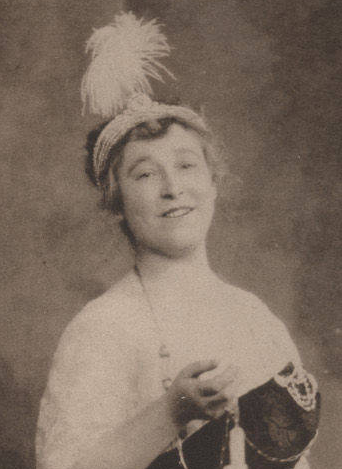
Irma Seydel - Composer and violinist
Seydel performed as the soloist in the Saint-Saëns Violin Concerto no. 3 with the Boston Symphony Orchestra on March 1 and 2, 1918. Her bio from the program is reproduced below.


The following clip shows Irma on the faculty of the Boston Conservatory:
The following clip shows Irma on the faculty of the Boston Conservatory:

Thursday, March 31, 2016
Laura Slade Innis: Song composer
I have found very little
information about Laura Slade Innis. According to this site,
which reproduces data from the United States Census, she was born in 1894, was
married to Clarance P. Innis, and had two children. The image of the original 1920
census form shows that Clarance (or Clarence) was a lawyer. I believe that his
middle initial is R rather than P; Laura’s stationery is printed “Mrs. C.R. Innis,”
and “C.R. Innis” is also listed in 1912 as a claim
agent for the St. Joseph Railway, Light, Heat, & Power Co. The obituary
of Innis’s daughter, Laura Virginia Innis Moseley and that
of another daughter, Mary Innis Campbell, provide some additional
information, indicating that the Innises moved to Seattle some time around 1925.
Clarence can be found as a lawyer in some cases there in the 1930s. The 1940
census also shows the Innises in Seattle.
Worldcat has Innis listed as
“L.S. Innis,” and lists three compositions under this name, “Enchantment,” “A
Tree at Dusk,” and “My Riches.” They are held only at the British Library at
St. Pancras. “My Riches” is the Schmidt publication, which can be previewed here.
A British Library staff member confirmed that the other two are also songs for
voice with piano accompaniment, published by Boosey in 1925 (“Enchantment” by
Laura Slade-Innis) and Schirmer in 1929 (“A Tree at Dusk” by Laura Slade Innis).
Although Innis published only
“My Riches” with the Schmidt Company, her letters (dated from March 1922 to
April 1924) refer to submissions of another thirteen pieces. Innis focused
primarily on solo songs, as ten of her fourteen pieces are referred to as
songs, two more as children’s songs specifically aimed at music appreciation
lessons, and one as a hymn (“Evening Hymn,” the only other piece for which
Innis names the title). One additional submission has its genre unspecified.
The Schmidt Company’s replies to Innis refer only to “My Riches”; there are no
letters about any of the other submitted pieces. This is anomalous; most
other composers’ folders dating from this period contain letters in which the
company rejects submissions.[1] I have
found no reason why this might be different in Innis’s case, and will refrain
from speculating at present.
[1] In earlier correspondence
around the turn of the century, the Company’s replies are often not included in
the folders, but they are included in bound letterbooks in many cases.
Friday, March 25, 2016
Jean Bohannan: Composer, organist, pianist, Lyceumite
Bohannan’s
extant correspondence in the Schmidt archive all dates from 1922. She published
“Intermezzo,” an organ piece in E-flat in 1913, but the only correspondence
regarding this piece is a reminder that it had been published “several years
ago.” In 1922, she submitted two more pieces: “How the Little One Came,” a solo
song, and “In Heavenly Love Abiding,” an anthem.[1]
The company did not accept these pieces. In her letter, Bohannan provides a
mailing address in Recoaro, Province of Vicenza, Italy, but notes that after
October 1, she will be in Milan.
I
have not found Bohannan in any reference books. However, I have found Jean
Bohannon, a.k.a. Mrs. Ord Bohannon, who I believe is the same person, despite
the different spelling. The Bohannons (as a couple and individually) were
active during the first two decades of the twentieth century as traveling
performers/lecturers in the Lyceum movement, as composers, and in musical
circles in Pittsburgh, PA.
Pieces
of which Jean (or Mrs. Ord) Bohannon (or Bohannan) is listed as a composer
include “Peace,
Sweet Peace” (1913), “We
Will Never Falter” (1908), “Grant
thy Peace” (1909), “Hark!
The Merry Bells” (1908), and “Saviour,
Breathe an Evening Blessing” (1909). These religious-themed compositions
are consistent with the type of work Bohannan mentioned in her 1922 letter.
Mrs. Ord Bohannan also composed and performed secular music, such as a song
cycle for quartet based on Tennyson poems called “The Sleeping Beauty,” which
was performed
for a charity event in Pittsburgh by a group that included her husband. The
Bohannans also apparently were involved in music instruction, as they are
listed as “Jean Bohannan, composer and pianist [and] Ord Bohannan, tenor and
impersonator” in an article announcing a graduation concert of the Wickersham
School of Music.[2]
Additionally, Bohannan was active in Pittsburgh Sorosis, a women’s club, at one
point being its president and at another time, chair of the music committee.
A
1906 article gives the most complete information I have found about Jean
Bohannan. Before her July 31 marriage to Ord Bohannan, she was Mrs. Franklin W.
Bearl. (Bearl died in 1904.)
In addition to Pittsburgh Sorosis, she was involved with the Tourist Club and
the East End YWCA, and had “been identified with women’s clubs for a number of
years.”
Bohannon/Bohannan
died in 1923. Her obituary provides strong evidence that the Lyceum performer
was the Schmidt composer. The obituary states that Bohannon was buried in Pittsburgh,
and had moved with her husband to Italy “about a year ago,” but needed to
return to the U.S. due to poor health. It concludes, “Mrs. Bohannon was a splendid
success as a composer, having at least 100 compositions ranging from Sunday school
solos and quartets up to male choruses.”[3]
Thus
far, I have been unable to determine Bohannan/Bohannon’s original last name or her birth year.
Correspondence
Box 11, folder 14
 | ||
|
Tuesday, March 22, 2016
Mary E. Furniss: composer of religious music
Blog
posts
Mary
E. Furniss
Furniss
is another composer who does not appear in any secondary sources that I have
been able to find. Her extant correspondence dates from 1920-1932, but the
earliest letter refers to some earlier discussions. Furniss has one piece
listed in the finding aid, “Be Thou Ever Near.” There is also some
correspondence regarding another piece “Be Thou My Guide,” but this may be the
same piece. Furniss lived in Malden and Melrose, Massachusetts. Based on
information in her letters, I estimate that Furniss was born no later than 1883,
but likely somewhat earlier. According to this site, Furniss
was born Mary Elizabeth Hendrick in 1853 in Smithfield, RI. I have not been able
to confirm this elsewhere.
Furniss’s
correspondence more explicitly shows gender constraints that do some other
composers’ letters. The earlier letters are from/to her husband, George W. Furniss.
George was a sales
representative for the Oliver Ditson Company, also of Boston, and
apparently had dealings with the Schmidt Company representatives (Crosby,
Austin, and Emery) through this connection. (George appears in several sources,
including commercial music trade journals and the Congressional record.) When
“Be Thou Ever Near” is first submitted, Austin writes to George rather than
Mary about specific considerations, even though George is in Los Angeles on a
sales tour. As George was away, Mary did answer the letter, but deferred
completely to the publisher’s judgment about alterations, writing, “As Mr. F thinks
an author is not a good judge of his own compositions … I shall appreciate your
favor carrying out any of your careful studied thoughts.”[1]
After
“Be Thou Ever Near” is accepted but while George is still away, Mary sends
Henry Austin a poem that she hopes can be published. This is not explicitly a
submission, but she asks for his opinion about it and for advice on how to
publish it. In a postscript, she adds, “NB: Poetry is not my husband’s forte.”[2]
The subtext of this postscript apparently means to explain why she sent the
poem directly rather than using George as an intermediary, and why she feels
comfortable sending it even though he did not offer any criticism or advice.
After
her song is accepted for publication, Mary gets bolder. In March 1921, she
sends Austin some endorsements of “Be Thou Ever Near.” These include statements
by a church choir director, a singer, and her daughter, who teaches mandolin
and guitar in Worcester. This letter contains no mention of George. In
response, Austin expresses the company’s hope that the number would sell well;
two years later, a receipt for (what I assume are) royalty payments shows that
the low-voice version had sold 250 copies.
For
the most part, business dealings between Furniss and the Company cease after
this, although some letters resume in 1929. Mary writes that George has been
confined to bed for over a year, having been struck by a car. She makes several
requests for company representatives to visit George, as she believes seeing
old acquaintances and hearing talk of business dealings would be beneficial for
his mental state. She appears disappointed to report that nobody from the
Ditson Company ever visited or wrote, despite George’s “over 40 years of
faithful service.”[3]
There is no evidence that Crosby, Austin, or Emery ever visited (one of these
correspondents writes that s/he had no automobile with which to do so), but the
company did respond with letters and holiday greetings, for which Mary
expressed appreciation.
Correspondence:
Box 28, folder 18.
Monday, March 21, 2016
Claire Chapman: Composer, teacher, missionary
Claire
Chapman's extant correspondence with the Schmidt Company dates from 1921 to
1928. Her American addresses were in Dorset, Vermont and Macon, Georgia, but
more of her correspondence comes from abroad. Chapman spent time in Asia as a
missionary for the Women's Union Missionary Society of America (WUMS), a group
that "was founded to provide a way for single women to be sent to Asia to
address the physical, educational, and spiritual needs of the women there"
(Historical Background). Her letters address neither her work as a missionary
nor her religious sentiments, but one letter is typed on the WUMS letterhead.
She apparently also lived for some time in Brooklyn, as she writes on 6/27/1921
"I have left the Brooklyn address."
I
have found no biographical information on Chapman in any source. I assume she
was born no later than around 1890, because she co-wrote a piece called
"Northfield Hymns for Young People" for a children's choir to sing during a 1910 gathering of a wide variety of Christians of various Protestant denominations. Chapman may have
immigrated from England, according to the 1915 Catalog of Copyright Entries.
Chapman's
only piece in the Finding Aid is the children's operetta "The
Farmerette" [(c)1921]. This work is intended for children to perform.
There are two human characters, the Farmerette and her assistant, several
vegetables (e.g., bean, beat, artichoke, corn, potato), some caterpillars, and
some "sunshine fairies." The music is straightforward and singable;
one theme that occurs at least twice is the melody from Schumann's movement
"The Happy Farmer" (op. 68, no. 10).
The
1921 correspondence is primarily concerned with "The Farmerette,"
addressing corrections in the proofs and the writing of an advertising blurb.
Mentioned at least twice in this regard is a colleague or friend, Miss E.E.
McCartee of Brooklyn, who I believe is shown here as an associate member of the Brooklyn Institute of Arts and Sciences.
In
addition to her children's compositions, Chapman had some aspirations to write
art music, and was interested in "exotic" music. In 1921, she wrote
" “I am trying to saturate myself
with the real spirit of this country’s music, which is most weird and
fascinating; I believe that if I could reproduce a modified form of it, it
would ‘take’ in America. … The national Japanese music is wonderful; some of
it, of course, is just noise, at least to my ears, and I am sure, would not be
especially popular in America. But some of the progressions take my breath away
with their barbaric beauty.”[1]
In its response, the company expressed great interest in Chapman's potential
appropriation of Japanese music and encouraged her to send along any such
music, writing, "so much of the modern music seems to have a leaning
towards Oriental color that I should not be surprised if you eventually the
Eastern tonalities are drawn upon by Western composers. In any case a more
general appreciation of Eastern Art by the West and Western Art by the East
cannot but lead to a better understanding between the peoples in general and
consequently is of very vital importance.[2]
Despite her teaching and supervisory duties in the Christian school, Chapman
did compose some pieces while in Japan, but all of her manuscripts were
destroyed in an earthquake. (I assume this was the 1923 Tokyo-Yokohama
earthquake, though she doesn't specify). Chapman was traumatized by the event,
which forced the closure of her school. She subsequently moved to China and
vowed to return to composing. However, to my knowledge, Chapman did not publish
any more pieces with the Company.
Correspondence:
Box 18, folder 15.
Saturday, March 5, 2016
Welcome!
Thanks for visiting my blog on women composers who published with the Arthur P. Schmidt Company!
As you can see, this is a work in progress. I hope to make a post for each of the lesser-known composers. In the meantime, you can go to one of the other pages (see navigation tabs above). Each has some additional information about the composers. I've made a Google map showing their locations, and a spreadsheet listing all the pieces in the Library of Congress's Finding Aid. In the spreadsheet, in cases for which I have the information, I have annotated the titles with information about instrumentation and genre, and provided links to the scores.
As you can see, this is a work in progress. I hope to make a post for each of the lesser-known composers. In the meantime, you can go to one of the other pages (see navigation tabs above). Each has some additional information about the composers. I've made a Google map showing their locations, and a spreadsheet listing all the pieces in the Library of Congress's Finding Aid. In the spreadsheet, in cases for which I have the information, I have annotated the titles with information about instrumentation and genre, and provided links to the scores.
Subscribe to:
Posts (Atom)